Saturday, January 25, 2014

Unlawful and Uncooperative Traffic Cop Operating Fraudulently Fines Good Samaritan

I have just returned back from being fined by a traffic cop, ostensibly for stopping to help him.

The camera was obscured a mere 42m behind the nearest Oleander bush, and thus was at a jaunty angle to the traffic. The camera was not on a firm and stable surface, but in the ditch in the traffic island. Officer Finlayson, number 10588968, refused to hand over the permit for the camera, and became obstructionist at the end of the discussion. He fined me for stopping on a freeway without putting out a triangle. As I was parked behind him, he charged me for an offense of which he was equally guilty. Are traffic cops above their own laws? The cop is still continuing to trap illegally as I was unable to stop him.
I do not know what to do at this point. Any suggestions are welcome, please send suggestions to capebio -at- gmail.com

Here is my transcript of the event.

The unmarked Venture CA175-822 was parked on the M3 near the Blue Route Mall turn-off, and had no hazard lights on, and no hazard triangle had been laid out behind the car. I ostensibly pulled off to find out if the driver needed assistance with his vehicle, but instead, after surveying the traffic camera, the cop stepped from his car, and told me that I had parked illegally on the side of the highway, and was going to fine me for doing so.
I pointed out to him that his traffic camera was illegally positioned, and that I would like to see his certificate. He said that I had not put out a traffic triangle, and thus he required my licence card, and that he would deal with my complaint after fining me.
I handed over my card, and patiently waited.
He asked me for my residential details, and I told him. He said that he didn't believe me, and that had he reasonable suspicion that I was not telling the truth, that he could detain me for up to 12 hours. I repeated my address, and he brightened up and said: "I know you! I met you once regarding a complaint near the Baxter theatre". After some moments of banter I insisted on proceeding with the issue at hand, and he then asked for my business address, and that I have to give it to him. I said that I did not have to give him my business address, as I may be unemployed.
He said, he would just write down UCT, Botany Dept.
After that asked me to sign. I said I was under no obligation to sign - so he wrote down Refuse To Sign.
He then tried serving me the notice, but I refused to accept it. He said that he couldn't force me to take it as that would be assault, so he said he would put it in my car, and walked up to my car. I said that I did not grant him permission to open my car door, and he looked uncertain for a moment before realizing that the window was open. Dropping the fine onto the seat, he said:" you have been served". He then told me that I had to move the vehicle immediately, as it was illegally parked. I said I would do so after he dealt with my complaint. He again ordered me to move it immediately or he would be forced to arrest me. I said that we had agreed that he give me the certificate.
He then walked back to his car and said that he was going to have to fine me for walking on the side of the freeway, and started writing out another ticket. 
I said that I insisted that he deal with my complaint about the camera being illegally positioned. He then handed me the certificate which I perused. It showed that the certificate of calibration was registered on the 4th of December, and that it was valid till the 04 June.
I then asked for the certificate of current calibration and permit for being there. He said that if I did not move the car immediately, he would arrest me.
I climbed back into the car, drove 300m till I was off the freeway and ran back to the cop.
I paced out 42 m from the obstructing bush to the camera that was in the centre of the traffic island. I told the cop I wished to speak to him, but he closed the window. He then proceeded to speak into his ipad. I then knocked on his window, but he ignored me. I said that my car had broken down and could he help me. He repeated what I said and laughed.
 I checked the spirit level on the camera. The centre of the bubble in the vertical plane was on the edge of the marking. i.e. not level.
I then walked in front of the camera, and he got out his car and said that would arrest me for obstruction of lawful duty if I obstructed the camera again. I said that the camera was unlawfully positioned, and that I required the camera permit. 
He climbed into the car and refused to speak to me.
I returned to my car and wrote this blog.
-TNB
Twitter: TNBloganist

Saturday, January 4, 2014

Cape Gooseberry under attack by herbivorous faeces!

What resembles a hunchback when curled up, throws up when disturbed, covers itself in its own faeces and eats leaves?


Faeces chomping my gooseberry leaf
A close up of  the dastardly herbivorous faeces.
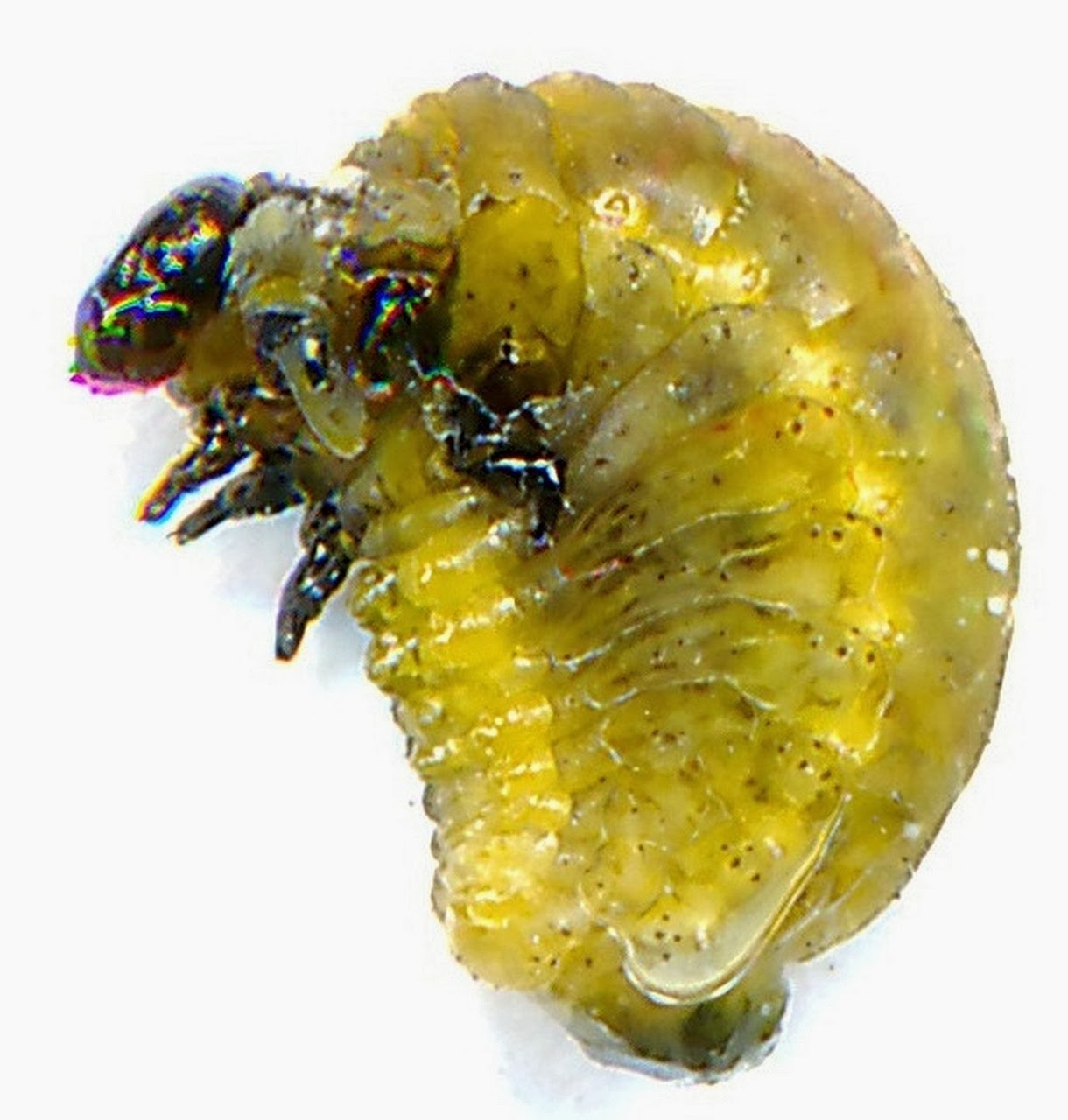
This morning, after a glorious few days break exploring my inner feminine at the Space of Love, and then exploring my overt masculine at the Annual Hermanus Camp, I returned to my garden under an(other) attack. The leaves and branches were speckled in squishy wet faeces that were evidently snacking on the leaves of my gooseberry plants. They had eaten a considerable portion of the leaves of the Cape Gooseberry (Physalis peruviana) bushes. Closer inspection revealed that beneath these faeces were larvae of Lema trilinea. With their tiny legs and massive bodies, these wouldn't look out of place guiding an alien craft through the cosmos. So perhaps the answer to the above conundrum, as suggested by my digsmate, is poo-worms?

A young worm with barely any faeces covering it.
The Cape Gooseberry is not from the Cape, but western South America. Rather, they are named from the cape/cloak that covers their blessed edible fruiting bodies. They are densely covered in hairs which due to their density, likely serve as formidable protection against microherbivores. However, once nibbled upon, the plant appears to activate a secondary defense. In harvesting the worms to incubate them, I found that leaves that were being nibbled on were much easier to remove than intact leaves. it would appear that the plant ejects its leaves to jettison its unwelcome guests. An expensive but possibly effective strategy for barely mobile pests.

The worms on the other hand have an unusual defense. From a very young age, they start accumulating faeces on their backs. These continue to pile up until the worm below is no longer visible. I've heard of organisms camouflaging themselves as turds, but to actually strap your toilet onto your back - that's an entirely different and gutsy defense! Talking of guts, their secondary defense is to puke when disturbed - just in case you weren't put off by their faecal shield.

If I could come up with an adage about my organic garden it would be this: For every food plant that thrives, it will, at some time, support an equally prolific pest that ensures that it doesn't.

I previously wrote about my strawberry plants being set upon by a veritable menagerie of pets pests including my dogs. The gooseberries, notwithstanding aphids, have thus far been my sole salvation. But no longer!
My solargooseberry plant with aphids aggregating within the cape.

What are these beasties that challenge my gooseberries as a crop, and further erode my ego as a gardener? Lema trilinea. I've never encountered them before. Here are scans of them.I would welcome identifications and information about them.


A worm resembling a hunchback from the side.

A Lema trilinea worm from below. The coloured legs are an artefact of the worm wiggling while being scanned.
Leaves showing considerable damage, and a recently hatched nesting site (RHS).

Close up of the hatching site.

In the centre-left, a clump of eggs can just be made out.

Close up of these eggs
A gooseberry with the cape having been devoured by the worms.
For more information about gooseberries including distribution and other common names, see Biodiversity International's New World Fruit Database. For their nutritional information see: http://www.fruitsinfo.com/Cape-gooseberry-tropical-fruits.php


Saturday, December 28, 2013

Karoo Stone Age Axe Kills Again After 500 000 Years

I AM A KILLER
A week ago I spared a rat's life because it was christmas - okay it escaped through the window - but it was christmas. Last night I entered my room, and a rapid movement made me realize I had left my window open and Miss Rodent had entered into my castle. I leaped forward to close the window narrowly cutting off his escape. I then spent five minutes with my software developer chad, hunting him around the bedroom. After several failed attempts to hit him with the axe, and step on him, Chad finally spotted the sessile tail lying behind the corner of the desk. I grabbed it with my fingers and hauled out the hapless lass.


Far from being a cold-blooded killer, I detest killing, but it had to be done. She had eaten a gift box of Dairy Milk chocolates, and the Acheulean Axe clasped between my fingers was baying for blood once again. I held Miss Rodent close to the ground and struck - crying out in a gutteral, primal, cry: once... twice... thrice I struck its head with the Acheulean Axe. Only on the fourth time did it finally roll over and succumb. I dealt the coup de grĂ¢ce, and dislocated its neck, using the edge of the axe to pop its head, and through the twitching corpse of Miss Rodent to our dog Jenny, who happily trotted off with him.

I felt neither elated nor sad. It had to be done. My home is my castle, and I will protect it from intruders. This was the first mammal I have killed with my hands, and may or may not be my last. You may criticize me about killing an animal, but if you eat - if you live in a home - then you too are a murderer. The only difference being that this time I was the direct vector of death.

Every plot of land that is carved up for either housing or food once upon a time had plants growing upon it. These plants had an entire ecosystem of insects including mammals thriving upon it. These were not simply displaced. Every human on this planet has a significant footprint. I am a killer. You are a killer. Your angelic children are killers. We are all murderers. The only question is what do you do to offset and minimize your impact on this planet??

Thursday, November 7, 2013

Food Fight! My Battle With Strawberry Pests.

My last post spoke of my battle with the shade. One of the survivors was my strawberries - apparently thriving and producing flowers and even fruit. I planted 22 plants one year ago, and I now have 140 (and I've given away a bunch). After one year, the time has arrived to finally start harvesting my produce. Having neglected my plants for about three days, with promising white to pink strawberries festooning the ground, I returned with great hope that I would find a bunch intact. I had even taken the precaution of placing the best of the strawberries on lids within bigger lids such that they were surrounded by a moat of water.

I leave you to judge the result!
Todays strawberry harvest. Yum!The 

Of my 21 ripe strawberries (I cast two into the road with snails attached), not one has survived intact. Every strawberry is either small, malformed (water or nutrient deficiency?), or rotten, or eaten by a combination of birds, snails, slugs, weevils, wood louse and millipedes. Until I started my own veggie garden, I did not even realize that wood louse and millipedes could be considered a pest. I thought they hung around mainly underground! Even my Solar Strawbs - an elevated pipe bearing strawberry plants, had one fruit that was not sufficiently hanging off the side entirely devoured by birds, and another with a millipede still chomping on it. Several entire plants have been ripped up by our friendly foraging dogs. Well, they have just been demoted to my second-best friend!

Woodlouse on a fresh organic home-grown strawberry


What is to be done about it, if The Naked Botanist cannot even grow his own strawberries in a wonderful organic setting which has never seen a pesticide in its life? I am certainly starting to have sympathy for non-organic farmers who utilize pesticide. Fortunately I am not surviving off my produce, nor making a living off them... but if I were?? Any recommendations?


Tuesday, November 5, 2013

Garden encounters of the Pulmatophageous kind

Giving my once promising garden the displeased eye, I decided to start rebuilding it. A long winter combined with a toxic cocktail of shade, neglect and a veritable menagerie of herbivorous pests have left my organic vegie garden a grassy and weed infested knoll. The survivors: a pitiful assortment of spindly carrots, a flowering broccoli, three snail-eaten spinach plants, and  a lone embittered beetroot. In fact the only chlorophyllous life that is thriving turns out to be strawberries and mustard. The latter which unlike the snails, I find akin to aloe juice and goose faeces on the unpalatability scale.

I attempted to beat into the soil a plank that served as a boundary to my former vegetabilian paradise. Unsuccessful, I hauled it out, revealing a small snake snoozing beneath the wood. How it survived my attempt to reseat the plank seemingly undamaged, I do not know. I scurried inside to grab my camera, and was just in time to witness a tail disappearing between the grass. Not having had time to identify the snake yet as poisonous or otherwise, I made a grab for the tale, and came up with an innocuous and unthreatening head dangling from my digitarial grip.


Having taken some photographs, I placed it on the scanner which resulted in these images showcasing its beautiful undercarriage. It turns out to be the common slug-eater, Duberria lutrix.


I've been told recently that its safe to hold a snake by the tail. Clearly this snake didn't get the message, as it quite happily lifted its head towards my hand, and as if trying out for a position at the circus - eased its way through the gap formed between my thumb and forefinger.

Oh, and in case you were wondering about the title - slugs are from the orders of Pulmonata, and phagy is latin "to eat".

Thursday, October 24, 2013

The advantages of living at the foot of a forest - Cicada scanned

Living within an ancient forest certainly has its advantages. Five minutes ago I flicked a cicada from my finger back into the nocturnal sodium twilight of the city. After flying around frantically in the room, I was surprised how calmly it sat while I scanned it. There were a few surprises in store for me when I examined the scan, and also when I read about them on Wikipedia.

My first attempt to scan - immediately after catching the cicada.
Please excuse the dust and scratches. Think of the cicada as an astronaut cicada with a giant finger holding it in place in space, and the twinkling dust of the stars in the background. From a quick search it seems like it could be Platypleura capensis.

Here you're starting to see the "pupils" of the eye that follow one around, and two bright dots.

Those three white dots turn out to be Ocelli

A view from the side
Did you notice curious things? What are those mirror-like things between the eyes? They are ocelli, very simple eyes that pretty much detect light vs. dark. It is theorized that it used in navigation and orientation, as the eyes are typically more sensitive than the primary eyes.

I also learned that they don't rub their legs against their bodies creating a rasping sound like many other insects, but they use tymbals, drum like organs with muscles that click each time they move in or out. Read loads more about Cicadas at http://www.cicadamania.com.


Wednesday, October 23, 2013

Where's That Hi-Res, USB 3.0 Colour Flatbed Scanner??

A quick rant about my Braun Slide Scanner 4000.
A few years ago I purchased a dedicated $1 600 Braun Slide scanner, which I used for several thousand slides before it broke. It was doing excellent work where I spent many hours scanning in precious images of biodiversity for free. I loved that I could rack up 100 slides at a time in a carousel, and leave it to run. I thought the software that came with it was somewhat lacking though. One day though, a slide caused it to jam, and try as I might I couldn't free it. I had to take it to a local photographic repair company for repairs where I was charged four times what the local repair man charged them, to have it taken to him. After repairs the scan feeder would only move backwards through the slides - inconsistently. Its been nearly a year since I personally took it through to Holland from South Africa via France and Israel, where I met a wonderful person on the train who promised to post it to Germany. A year later it is still at the Braun Factory for repairs. We're at a bit of a stand-off, because I missioned to get my scanner to them, and yet they are still insisting on payment. I would have hoped for better from what I believed to be a credible German company.

Erica cygnea - one of 1100 slides scanned in by my Braun Slidescan 4000 from Keith Kirsten's Erica collection

A fun picture of an old school geezer with Erica daphniflora

Flatbed scanning: The Canoscan 8800F, A robust workhorse!
This article however is focused on flatbed scanning, particularly for scanning 3-D objects, particularly plants. My mainstay has been my Canoscan 8800F. This has been an incredible workhorse with which I have scanned in hundreds of squashed plant specimens, carted it around the country on dusty rugged dirt roads in the Crazy Daisy on field trips, and dropped it at least once off the table where I had precariously balanced it - and yet still she lives!

I've been scanning in live specimens, dissecting them, and arranging the pieces. The results have been close to spectacular (Fig. 1). At full resolution, or 4800 DPI, It is possible to see nearly every hair and gland on a leaf or flower (Fig. 2). I have come up with the workflow that allows me to remove the background and put together a plate in about an hour. However, it's been three years since Canon brought out the affordable Canoscan 9000F flatbed scanner. One would have thought that by now technology would have improved somewhat. What would that wish list include?

Fig. 1. A composite of Hermannia concinnifolia
Fig. 2. A close-up of a petal showing the hairs on the claw

More Speed!
On the top of the priority list would surely be USB 3.0 connectivity, available since 2008! Scanners are notoriously slow at high resolution, churning out hundreds of megabytes. The data needs to be acquired by the scanning device, processed locally, then pumped through to the computer for storage. An inch of scanning at 4800 DPI probably takes one minute. It takes 22 seconds to initialize and calibrate the scanner at this resolution, finishing the task in 1 min 25 seconds. They all tout the warm-up time being zero for LED lamps, but what about this not insignificant initialization time?? For a several inch long object, this becomes very significant.

I feared I was alone in ranting about this, but I see that this photoreview website states that:" Although the CanoScan 9000F boasts an 'instant' warm-up time, it actually takes roughly five seconds before it starts working after one of the direct buttons is pressed. This is because each scan involves capturing a preview which includes preliminary adjustments". 

The warmup time at a lowly 300DPI is still six seconds for the initial calibration. Thereafter it is 3 seconds. A 300 DPI scan is four seconds. I notice on the Canon 9000F it touts a blistering 7 second speed to scan in a full A4 colour page at 300DPI. In other words exactly the same blistering speed as the 8800F on the shelves in 2007 already. Five years later still the same unimproved blistering speed!

Higher resolution
Although 4800DPI scans are great, they just can't quite resolve the smaller hairs and details of plants. 9600 DPI is only double this. We should be pushing for greater scan resolutions, though arguably if one wants that much detail - get a microscope!

Maximum scan size
Additionally, there is a maximum size of 21000 x 30 000 pixels which equates to 4.3 inches x 6.25 inches. I'm sure there is a perfectly good reason for this limit, but I would love to know what it is. Fortunately a quick Google search reveals that the Canon 9000F mark II increases this maximum resolution to 50 000 x 50 000. A welcome change in size.

3-D scanning.
It is said that for 3-D scanning, equivalent to using the scanner as a camera, a good depth of focus is needed.
David Walker reveals in his post that there are two kinds of consumer scanner sensors: CIS (Contact Image Sensor) and the CCD (Charge Coupled Device) designs. CIS, a relatively recent innovation is more compact and energy efficient with the sensor lying very close to the glass. Additionally they are relatively cheap as they dispense with the lens, mirror, lamp, and the A/D chip. The CCD on the other hand, as Carl McMillan shows, gives far superior depth of field however, about one inch of useable DOF. For 3-D scanning we clearly need a maximum depth of field, so CCD is the route we need to take. This means that for 3-D scanning, a thin scanner like the LIDE series is NOT what you want.

Light fall-off
Light fall-off is the best term I can find for the rate of reduction in light from the light source to the object, and back to the sensor. Now although light dissipates at a known rate from a point source, this is not the case for a focused source like a torch. This is something that LED's natively do. So why do my objects fade into black so quickly. This has a number of negative impacts. I lose a significant amount of the plant into the background. Furthermore it becomes increasingly difficult to demarcate the black background from the object, leading to the most horrible artefacts where the magic one has decided to include the object in the background, and thus remove it. Is this necessary? Can a future model of scanner provider greater depth of field and a greater penetration of light?

A demonstration of the artifacts of light fall-off on Hertia alata.
Note the distant foliage that could not be seperated from the background
so was effectively cut out.
Shadows
The shadows thrown by the plant onto the background screen are the absolute bain of my existance. I spend maybe half an hour instead  of 3 minutes isolating a plant from the background when there are significant shadows. Putting the sensor closer to the lightsource may help reduce the shadows. Otherwise is there some clever software or hardware solution??
So one squashes the plant and provides a white background to avoid light fall-off,
only to encounter the dreaded shadows that take an ETERNITY to isolate from the plant.


Passive scanning
Why does no scanner thus far allow for passive scanning, or at least a customisable light source brightness? The rationale is that for artistic and 3-D scanning, it would be nice to use natural or other light sources. Now although LEDs are arguably not dimmable, using rapid switching technology should allow one to customise the effective brightness of the LEDs. Combined with a customisable passive scanning option, this would allow the scanner to do a quick scan without lights, perhaps a second active scan, and then using that information provided user tunable options to light the 3-D object optimally.

Automatic compositing
Say you have a document or object that doesn't fit on the scanner. Simply scan one part of it, click on the "scan next portion" button. Move it, leaving an overlapping section. And scan again. The scanner automatically stitches them together based on overlapping pixels. Theoretically! Why does no scanner include this as a standard feature?! Grrr.

Black Background Technique
A user recommends using a black cloth to remove the background. I experimented with numerous cloths trying to find The most matt one, including velvet, but found that invariably dust or reflections would wreak havoc with my black background. Finally I settled on a box which I place on the scanner. My current box has a depth of about 40 cm, and even the dark red colour of the box does not show in my scans. This has the added advantage of not disturbing carefully placed arrangements on the page, like a cloth would do., including velvet.

JPEG XR Format
Oh how I lament the fact that no cameras save as JPEG XR -but that is a topic for another blog. The JPEG XR codecs have been out since 2009 and it is supported by most good image software such as Irfanview and Photoshop. There are a whole bunch of advantages to saving images using  JPEG XR as it offers numerous advantages over JPEG including: better compression; lossless compression (with, tiled structure support (so that only a portion of the image needs to be decoded); greater colour accuracy including 24-Bit RGB (true colour) and even 48-Bit integer RGB (deep colour); greater HDR support; greyscale and multi-channel colour codings (so one should be able to store the infra-red information); and transparency support through an alpha channel. In a nutshell, JPEG XR provides better image quality at less than half the file size with a bunch of useful image options, and lossless compression at 2.5x smaller file sizes than the original data.

So come on Scanner companies. Its been 5 years since we've had any major strides in the consumer scanner field, and no, upgrading the software on the 9000F and calling it mark II does not count! Here are a bunch of obvious milestones that could (read should) be implemented in a nearby future model. USB 3.0, easy. JPEG XR, just a codec implementation. Passive scanning - switch off the LED's for a start. And surely you can be more honest about the start-up time, and find ways to reduce that, like not calibrating it every time you scan at the same resolution!

That list again:
1) More speed including quicker start times, quicker scan speed, and quicker transfer speed (USB 3.0).
2) Greater depth of field (probably not so easy to implement).
3) Automatic stitching option for large objects.
4) Passive or even better, adjustable light acquisition.
5) Dealing with shadows cast by 3-D objects
6) Better compression - implementation of JPEG XR.
7) Higher resolution - have we really maxed out at 9600DPI native resolution?

Posted 23 Oct 2013 by
TNB
Twitter: @TNBLoganist
email: capebio (at) gmail.com